A television doesn’t have to compete with your art, or disappear behind cabinet doors, to look at home in a thoughtfully designed room. In 2026, one popular approach is to treat the screen as part of the composition: a practical focal point with artwork arranged around it.
The key is planning the whole wall together. When you choose the TV’s position, frame sizes, spacing, lighting, and installation method as one coordinated design, the result feels intentional when the screen is on and when it’s off.
Whether you’re planning a living room refresh or a commercial art installation in Florida, these steps can help you bring the TV and artwork together.
Start with the viewing position, not the empty wall
It’s tempting to begin by placing art where it looks attractive on a blank wall. But the TV has a job to do, too: it needs to be comfortable to watch from your main seating area.
Sit where you’ll watch most often and consider your eye level, viewing distance, windows, and lighting. For sofa viewing, a screen center near seated eye height, often around 40–44 inches from the floor as a starting point, may feel comfortable. Your room and seating may call for something different. Follow the TV and mount manufacturers’ instructions, too. Samsung’s wall-mounting guide offers additional placement and installation considerations.
This is different from placing framed art at a standard centerline. Firehawk generally places artwork with its center around 58–62 inches from the floor, but that measurement isn’t a rule for a television. Set the screen for comfortable viewing first. Then design the gallery around it.
Make the screen part of one larger composition
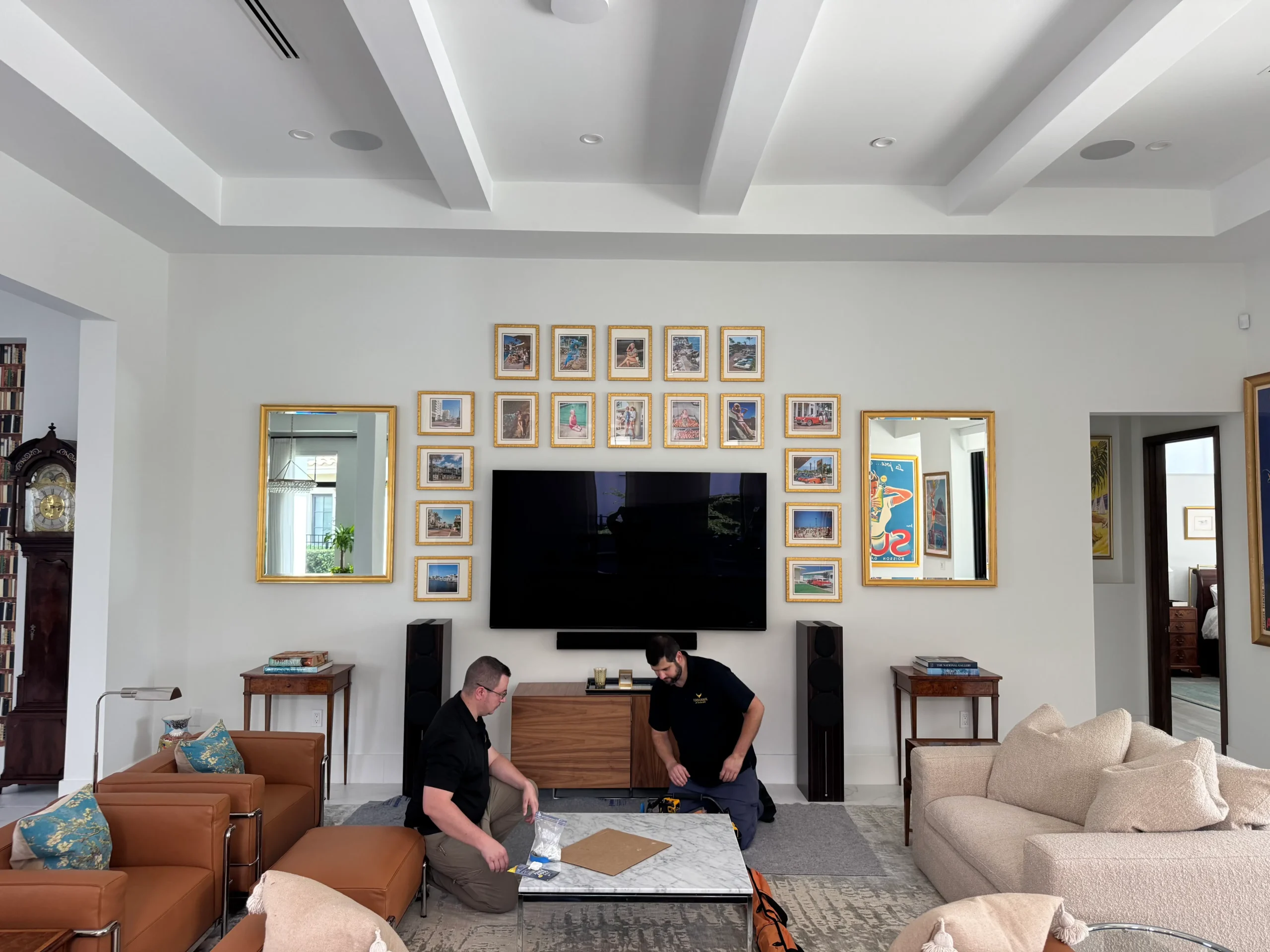
Think of the TV as the anchor of the gallery wall, not a hole the art needs to fill. You can build around it with a balanced grid, matching frames on either side, or a looser arrangement with a clear outer boundary.
A few layout principles help:
- Balance the visual weight. If one side has larger or darker pieces, use the other side to create a similar sense of weight.
- Repeat a detail. Black frames, warm wood, a shared mat color, or a recurring tone in the artwork can connect the screen to the collection.
- Give the TV room to breathe. A gap of roughly 4–8 inches between the screen and nearby art can be a useful starting point, then adjust to suit the scale of your pieces.
- Plan for movement. If the TV mount swivels or tilts, leave clearance for the screen’s full range of motion.
- Check the edges. Imagine a boundary around the entire arrangement. The TV and art should feel like one considered installation, not separate elements competing for attention.
Before drilling, mark the screen, frames, console, and soundbar with painter’s tape or paper templates. Step back. Check the layout from the sofa and from the room entrance. A little time with a mock-up can save a lot of patching and rearranging.

Make sure the wall works when the TV is on
A gallery wall should look good in daylight and under evening lighting, and shouldn’t make the screen harder to watch.
Look for reflections from windows, lamps, glossy frames, mirrors, or metallic finishes. If something reflects directly into the screen or catches your eye from the sofa, try adjusting its position or choosing a less reflective finish. Test the room from the seats you actually use, at different times of day.
Keep the TV’s ventilation openings clear. Make sure a soundbar, artwork, or decorative trim won’t block the speakers, remote sensor, or other equipment. For a built-in or tightly planned arrangement, check the clearances in the TV’s manual rather than assuming the space will be sufficient.
A well-composed wall also accounts for cables and access. Plan how power and AV connections will reach the TV before installation. Don’t conceal an ordinary power cord inside a wall; use an appropriate, listed in-wall power solution or ask a qualified electrician about the right option for your project.
Match the hardware to the TV, the art, and the wall
The design may be carefully balanced, but the installation still needs to be secure. TV mounts and artwork require hardware suited to their weight and the wall behind them. Drywall alone isn’t a reliable mounting point for a heavy TV or oversized frame.
Before installing, identify the wall type and locate suitable structural support. A mount that works for one wall may not be right for another, so follow its installation instructions and use hardware rated for the specific application. Check for wiring and plumbing before drilling. If the wall is concrete, tile, plaster, or another challenging surface, or if the TV is large, heavy, or mounted above a fireplace, it may make sense to bring in a qualified professional.
The artwork needs the same care. A light frame may be simple to hang yourself. A heavy mirror, large piece, high ceiling, tricky wall, or multi-piece gallery wall deserves a closer look at the support, spacing, and placement before anything goes up.
If you're deciding whether to bring in help, a few questions will tell you a lot before anyone picks up a drill. Our Florida Homeowner's Fine Art & Mirror Installation Guide covers 10 of them, from insurance and wall substrate to heavy-mirror strategy and high-reach work.
Consider how the wall reads in a home or commercial space
In a home, the gallery wall often needs to work with furniture, daily traffic, and a clear view from the main seating area. A console beneath the TV can help ground the arrangement, but leave enough room for equipment and avoid crowding the screen.
In a hotel, clinic, office, or clubhouse, the wall may need to fit a larger design plan, a fixed furniture layout, or an occupied space. For designers and art consultants, elevations and a piece schedule can help keep placement consistent. For contractors and procurement teams, confirming wall types, access, installation timing, and insurance requirements early can make the install easier to coordinate.

Plan the installation as one coordinated job
A TV and a gallery wall share the same space, so their installation should be coordinated. Start with the seating position and TV location. Confirm the mount, wall construction, outlets, cable route, ventilation, and any soundbar or other equipment. Then lay out the full artwork arrangement around the screen.
A careful installer can help you review the placement before drilling, keep the composition level, and choose appropriate hardware for each piece and wall surface. That can be especially valuable when the wall includes a heavy mirror, numerous frames, a high ceiling, or a commercial schedule that leaves little room for rework.
Firehawk installs TVs and art, as well as full gallery walls, for homeowners, interior designers, art consultants, contractors, and procurement teams across Florida. Our work includes more than 2,700 installations, and Firehawk holds a 5.0 rating across 100+ Google reviews. Museum-grade hardware is included, and certificates of insurance are available for commercial projects.
A simple checklist before you commit
Before the first hole is drilled, confirm:
- The TV is positioned comfortably for your main seating area.
- The mount suits the screen and wall construction.
- The artwork feels balanced around the TV, with enough clearance for any moving mount.
- Glare, lighting, ventilation, sound, and remote access have been considered.
- Power and AV wiring have a safe, serviceable plan.
- Each frame and mirror has hardware suited to its weight and the wall.
For more layout ideas, see Firehawk’s gallery wall design guide. Homeowners can learn about residential art, TV, and mirror installation; designers and art consultants can explore installation services for designers; and contractors can review commercial installation support.
A gallery wall that feels considered
When you plan the viewing position, screen, artwork, and installation together, the TV doesn’t need to be hidden or treated as an afterthought. It can become one part of a balanced wall that works for your room and the way you use it.
If you’re planning a gallery wall, a TV installation, or both, contact Firehawk to talk through your space and next steps.